
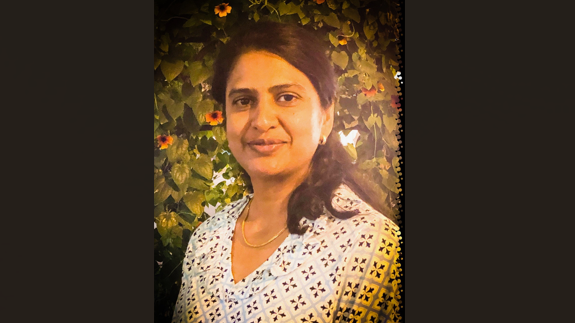
Deepa learned about CAA when the CAA leaders came and spoke to her West Valley College class.
A Special Kind of College
What happens when college ends, but learning doesn’t?
For adults with intellectual and developmental disabilities, the desire to build
relationships and be part of a learning community does not have to end when formal
schooling ends.
I recently had the opportunity to interview Dr. Pamela Lindsay, Co-Founder and Director
of Research and Programs at the College of Adaptive Arts (CAA), and one part of our
conversation stayed with me. We often talk about inclusion in education as making sure
all students, regardless of their background or abilities, have access to a classroom or
support services. But my conversation with Dr. Pamela Lindsay made me think about
something beyond access to a classroom: What happens when the classroom itself
ends?
In California, students with disabilities who qualify for special education services can
receive those services through age 22. The California Department of Education explains
that special education serves individuals through age 22 and that transition planning
helps students prepare for life after school, including employment and adult life. When
students reach the end of their eligibility for public-school special education services,
they leave the school system. Some may move into employment or other
community-based services. However, there is not an automatic transition into college or
another lifelong learning environment. For some adults with intellectual and
developmental disabilities, leaving school can also mean losing regular access to
teachers, peers, activities, and the experience of being part of a learning community.
That gap is where CAA began.
Dr. Pam shared that the idea for CAA grew from a theater and choir program she was
teaching students with disabilities. As some of her students approached the age when
they would leave school-based services, she and DeAnna Pursai, an educator and
disability advocate committed to building more inclusive communities, began thinking
about what would happen next. These young adults were growing up, but there were
limited opportunities designed around their lives as adults. They began asking whether
there could be an educational experience where these students could continue learning
and participating in a community with other adults.
That question eventually led to the founding of the College of Adaptive Arts (CAA) in
2009 by Dr. Pamela Lindsay and DeAnna Pursai. CAA provides a lifelong collegiate
experience for adults with intellectual and developmental disabilities. It began with just
12 adult students in one musical theater class and has since grown to 317 students
enrolled in the Summer–Fall 2026 semester, taking classes across 10 Schools of
Instruction, with 1,435 learning seats available each week.
Today, CAA’s flagship campus is at West Valley College in Saratoga, California. This
partnership gives CAA students the opportunity to continue learning and growing on an
authentic college campus. It also creates opportunities for West Valley College students
to participate through service learning, work-study, and leadership training. CAA offers
courses in areas such as Visual Arts, Business, Communications, Dance, Health &
Wellness, Leadership & Civic Engagement, Music, Science & Technology, Theatre, and
Digital Media Studies.
But what resonated with me most from my conversation with Dr. Pam was not the list of
programs. It was the idea behind them: adults with disabilities are still growing, still
developing, and still figuring out what they want to do next. As Dr. Pam put it
during our conversation, “What do you need now? Let’s work on it.”
That idea changed how I thought about inclusion. Inclusion is not simply placing a
person in a classroom or providing an accommodation so they can participate. It also
means creating opportunities for people to have peers, make choices, take on
responsibilities, build relationships, and feel that they truly belong.
CAA serves adults of different ages, from young adults to older adults. Dr. Pam
described how important it is for CAA students to have opportunities to be equitably and
inclusively involved with peers their own age and older. This matters because being an
adult means having experiences that are appropriate for your age and stage of life. A
young adult should have opportunities to meet and learn with other adults, rather than
simply continuing in programs designed for young children.
That may seem simple, but it is easy to overlook. A person can receive services and still
not have a meaningful sense of belonging. A person can be included in an activity and
still not have choices about what they want to learn or do. CAA’s approach starts from a
different place: What does this adult need at this stage of life, and what
opportunities can we create around that?
This is where I see the connection to CAA’s focus on lifelong learning. Designing
opportunities around an adult’s stage of life does not mean learning stops at a certain
age. It means recognizing that adults continue to learn and grow throughout their lives.
They can build new skills, develop relationships, gain confidence, explore interests, take
on responsibilities, and discover new parts of themselves.
For me, that is what makes lifelong learning more than a phrase. It means recognizing
that adults with intellectual and developmental disabilities also deserve opportunities to
keep learning and growing throughout their lives, in ways that are meaningful to them.
Furthermore, I was keen to explore how CAA approaches the curriculum because its
students have very different learning needs. Dr. Pam explained that she developed what
CAA calls its Arts Instructional Model, a framework that begins with shared topics and
concepts but allows the materials and instruction to be adapted to individual learners.
One example she shared involved reading. Students might work with the same story,
but one student may use a picture-supported or simplified version while another works
with longer passages or a full novel. They are still learning together, but they do not
have to learn in exactly the same way.
This approach is particularly striking: learning together does not mean learning the
same way. Students can share a classroom, a subject, a skill, and a sense of
community while having different goals and different ways of reaching them.
Our conversation also covered aspects of workforce development. CAA has a
vocational and work-study component, and some students use it to explore employment
opportunities. Dr. Pam explained, however, that many students are already working and
may not need or want additional workforce training. Some are comfortable with the work
they already do and feel proud of it.
This raises an interesting question about an assumption we sometimes make about
education: that its value has to be connected to getting a job. Employment can certainly
be an important part of adult life, but it is not the only reason someone might want to
continue learning. A college community can also give adults opportunities to develop
friendships, discover interests, participate in the arts, take on responsibilities, make
choices, and continue growing. Work can be part of that picture without being the entire
picture.
CAA does not fit neatly into the conventional degree-and-credit model of higher
education. Its students are not generally there to earn traditional college degrees or
academic credit. Yet the experience still contains many things we associate with
college: learning, community, relationships, personal growth, choice, and participation.
That is what I found most interesting about CAA. It does not simply ask, “How can we fit
adults with disabilities into the college model that already exists?” Instead, it asks a
different question: What kind of learning community do these adults need?
And perhaps that is why the word college matters.
College is not only about a transcript or a credential. For many people, college is also a
place to meet people, try something new, develop confidence, discover interests, and
figure out what comes next. CAA creates those opportunities for adults who may
otherwise have very limited access to a college community after traditional education
ends.
Our conversation left me thinking about a question that reaches beyond CAA: What
should happen when one educational pathway ends, but the desire and need to
learn continues?
CAA does not provide a traditional higher education pathway, and it does not claim to
replace one. Instead, it creates another kind of opportunity to keep learning and remain
connected to a community. That is the key takeaway: when formal schooling ends for
adults, their desire to learn based on their interests, opportunities to grow at their own
skill level, and their sense of belonging to a learning community should not end with it.
By Deepa G., West Valley College Child Development Student